
Stand Alone LTC


Long-term care planning is an essential part of a well-rounded financial strategy. As people live longer, the likelihood of needing assistance with daily activities—such as bathing, dressing, or mobility—increases significantly. Without proper planning, the cost of care can place a heavy burden on both personal finances and family members.
Today, there are three main types of long-term care (LTC) solutions, each designed to address these needs in different ways.
1. Understanding the three types of LTC solutions
When exploring long-term care planning, it is helpful to understand the three primary options available:
- Stand-Alone Long-Term Care Insurance
- Hybrid Life Insurance with LTC Benefits
- Annuity with LTC Riders
Each option has its own structure, flexibility, and cost considerations. In this article, we focus on stand-alone LTC insurance, a dedicated and often cost-efficient solution.
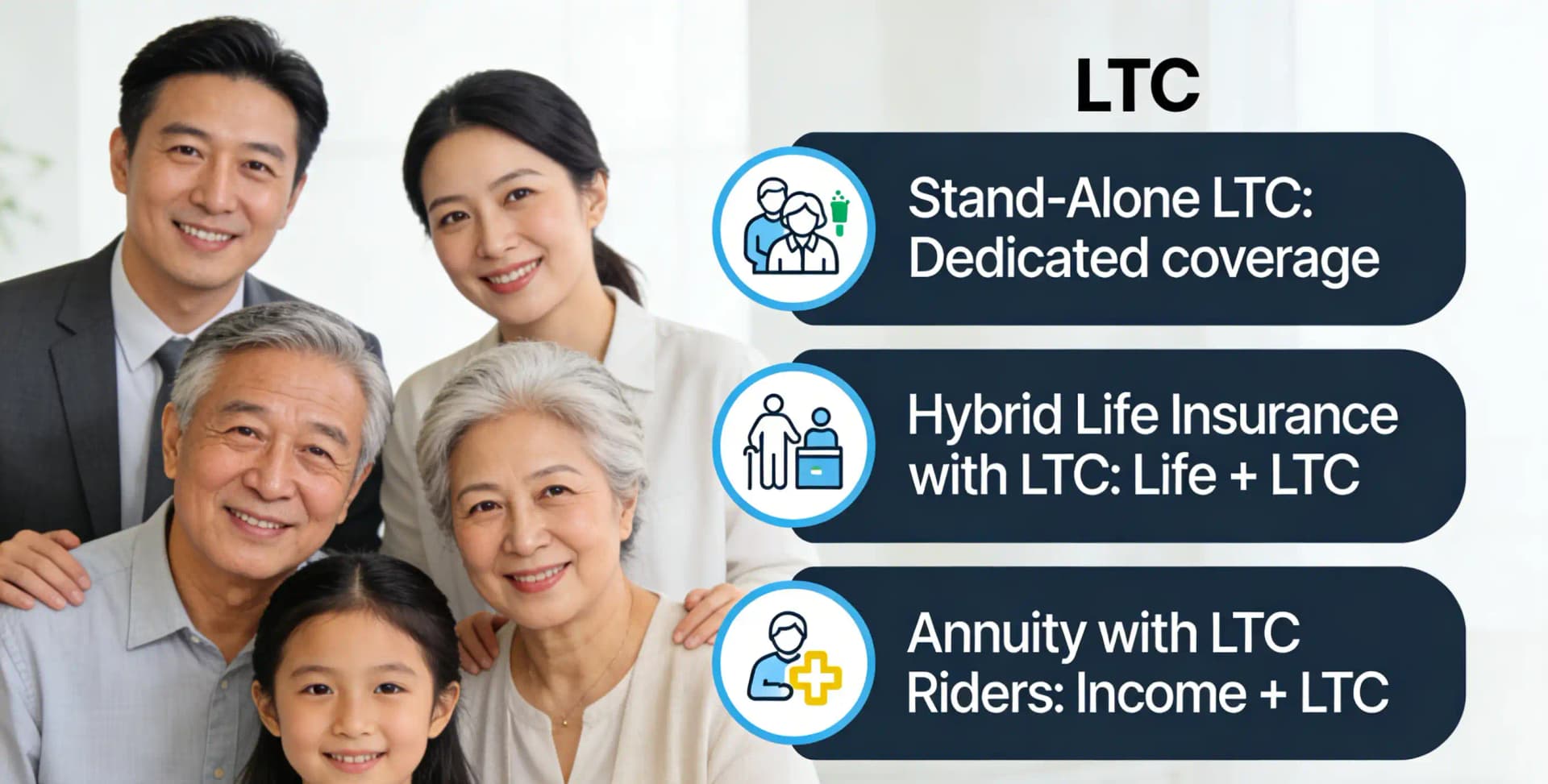
A structured approach to future care
Understanding these three categories helps individuals make informed decisions based on their financial goals, risk tolerance, and family situation.
2. What is stand-alone LTC insurance?
Stand-alone LTC insurance is a policy designed specifically to cover long-term care services. Unlike hybrid solutions, it focuses entirely on care-related expenses.
It can help cover:
- In-home care and assistance
- Assisted living facilities
- Nursing home care
- Adult day care services

Dedicated protection for care needs
This type of policy ensures that individuals can access quality care without relying entirely on personal savings or family members.
3. Key benefits of stand-alone LTC
Stand-alone LTC insurance offers several important advantages:
- Dedicated coverage for long-term care needs
- Cost efficiency compared to hybrid solutions
- Flexibility in choosing care settings
- Asset protection for retirement savings
Focused and efficient protection
For individuals seeking a straightforward solution, stand-alone LTC provides clear and purpose-built coverage.
4. Important consideration: use it or lose it
One important aspect to understand is that stand-alone LTC insurance is designed purely for protection.
If long-term care benefits are never used, the premiums paid into the policy generally do not return as a financial benefit.
This characteristic is often referred to as the “use it or lose it” feature.
Understanding the trade-off
While this may be seen as a disadvantage compared to hybrid products, many view it as similar to other types of insurance—providing protection against significant financial risk rather than serving as an investment.
5. Key features to evaluate
When considering a stand-alone LTC policy, it is important to review:
- Benefit amount (daily or monthly coverage)
- Benefit period (duration of coverage)
- Elimination period (waiting period before benefits begin)
- Inflation protection options

Planning for long-term stability
These features can be customized to align with your long-term financial goals and anticipated care needs.
6. Who should consider stand-alone LTC?
Stand-alone LTC insurance may be a strong fit for individuals who:
- Want dedicated long-term care coverage
- Prefer a cost-effective solution
- Wish to protect retirement assets
- Value independence and flexibility in care options
A practical choice for long-term security
It is particularly suitable for those who want clear separation between protection and investment strategies.
7. When should you plan?
The best time to consider long-term care planning is before retirement, when you are generally healthier and have more options available.
Early planning helps secure better coverage and provides greater long-term financial stability.
Final thoughts
Long-term care planning is not just about managing costs—it is about protecting your independence, dignity, and family.
While multiple solutions exist, stand-alone LTC insurance remains a focused and practical option for those seeking dedicated protection.
Planning today creates confidence for tomorrow.
Click here for consulation.
Learn more
Explore related topics:
- Hybrid LTC vs Stand-Alone LTC
- Retirement Income Planning Strategies
- Asset Protection in Retirement
- Healthcare Planning Essentials